
The first year of a child is full of changes. Over the months, they become more talkative, move around a lot, and begin to assert their preferences. What are the key milestones of this year? And how do we support them?
Let’s begin by acknowledging that “growth” and “development” are two interconnected yet distinct processes. That’s why a pediatrician will not only measure a child’s weight and check other growth standards but also inquire about their development: their movements, cognitive skills, visual communication, speech, and language development. Although every child develops at their own pace, based on their genetic heritage and personality, there are certain benchmarks, an age at which we expect certain acquired developments.
We will now review the major stages of this development, focusing on gross motor skills and the required stimulation. You will learn how different developmental domains interconnect and how parents can provide the environment and stimulation their children need to reach their full potential. Remember, development is not a linear process, and children can skip stages or learn motor skills simultaneously. So, you can refer to these guidelines merely as broad strokes for understanding the principles of child growth.
From Birth to 2 Months
Let’s start at the beginning. At birth, we see the clear continuation of the child’s physiological state in the womb. Their movements are spontaneous and agile, with the whole body moving, continuing the movements of the child in the womb. They turn their head from side to side. Ensure they are placed on a comfortable surface. At this stage, the child moves through primary reflexes. Their vision is not fully developed yet, and they perceive best high-contrast colors. Place your face about 25-30 cm away from theirs and speak or sing softly. Babies have a clear preference for faces and remember your voice from before their birth.
The child continues to grow with time and the stimuli they encounter (touch, sound, sight). By two months, the child is already making progress. They have better control over their head and can keep it in the midline. Their back and pelvis elongate and flatten. When lying down, their whole body is in contact with the mattress. They can now fixate their gaze and smile voluntarily, in response to your smile.
From 4 to 6 Months
As the child grows, their large muscles (back, abdomen, buttocks) strengthen, and their small muscles (fingers, eyes, toes) develop. We’ll see them starting to desire reaching for something (especially with their feet – so place toys where they can kick them or make sounds).
These initial attempts to grasp won’t always be successful at first, but with time and practice, accuracy sets in. It’s one way the child starts to grasp the cause and effect relationship and control their environment. At this time, you’ll also see them rolling over unintentionally. Their head is still heavy, and if they turn it to look at something, their body might follow, sometimes leading to unexpected turns. These unintentional movements are often accompanied by surprise or crying.
Over time, the child will refine these actions. When lying on their back, they strengthen their abdominal muscles and lift their legs and chin. Hang toys in different places. They will reach their hands in different directions, thus strengthening different muscles. The more varied the experiences, the more effective the learning.
The midline becomes very clear. The child extends their limbs and brings their feet together.
6 Months and Beyond
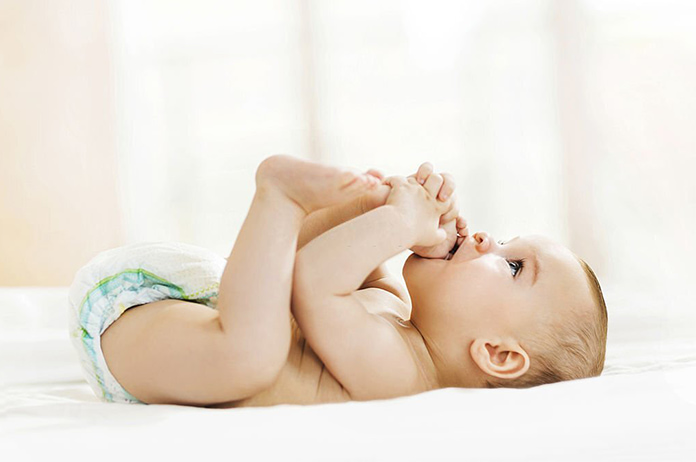
Around 6 months, the child begins to roll over. Their arms and trunk are now strong enough to support themselves on their extended arms. Whether lying on their back or stomach, they can reach for anything precisely. Place a toy at an angle for the child to encourage turning in that direction. They can now differentiate between pelvic and shoulder movements. They can flip onto their side and play. They turn and go from their back to their stomach and appreciate this position more and more. On their back, they see the wonderful relationship between their hands and feet. They’ll enjoy grabbing their knees or ankles and pulling their legs to bend them. This is fantastic. They’re learning to recognize their body, tense their muscles, and touch their legs and feet with their hands and mouth. Soon you’ll see the first attempts at crawling. It’s not uncommon for the child to crawl backward at first. As with any motor learning process, beginnings can be challenging and messy. Practice, creating an open and supportive environment, a reasonable distance of play, and lots of encouragement will inspire the child to exert effort. The child goes further, exploring their world and testing its limits. Your presence is necessary. Be present and attentive. Your encouragement, cooperation, and guidance are sought.
From 8 to 10 Months
Around 8 months, their muscles are strong enough for them to start crawling on all fours. They may be wobbly back and forth. It’s a completely natural way to prepare for crawling and standing up. This back-and-forth movement stimulates the vestibular system (the balance organ) and helps bone and joint compression. You’ll also see them sitting sometimes. The child lies on their side and takes support on their hands and sits. This is the perfect time to place toys within their reach when sitting. The child is strong enough to keep their back straight and maintain balance. They won’t fall forward anymore, and soon they won’t fall sideways either. Then they develop mechanisms to prevent falling backward. When choosing a play area for a sitting child, also consider what’s behind and beside them. Everything should be safe. Sitting position enhances the development of vocal abilities, creates a new field of vision, and makes hands more available for exploring the world further. Back and shoulder muscles are strong enough to stabilize the body, and hands and fingers are now available for more advanced and voluntary play: reaching, grasping, releasing, pulling, and rotating.
10 Months and Beyond
Once they know how to stay seated, the child will start crawling and then cruising. Development is a dynamic process and occurs simultaneously. It’s natural. After about ten months, we’ll see the child assisting themselves in standing up and relying on furniture, toys, etc. It may be awkward at first, but practice will prove it highly effective. Standing up is a motor development that gives the feet a pivotal role but is still unknown: to support body weight. It’s discovering new challenges, maintaining balance while leaning your body on a small surface only, and seeing the world from above. Fortunately, the rewards are extraordinary: a new field of vision opens up, and interesting motor challenges arise. This is also the beginning of walking. Once the child gains confidence, they won’t be able to stop cruising around furniture and grabbing onto everything within their reach, including toys. So, it’s imperative for the child to develop in a safe environment. Initially, they’ll move horizontally, then vertically, and then they’ll be able to rotate their body. Eventually, the child will let go and continue practicing unsupported. The child is now ready for walking and moves on to the next step.