

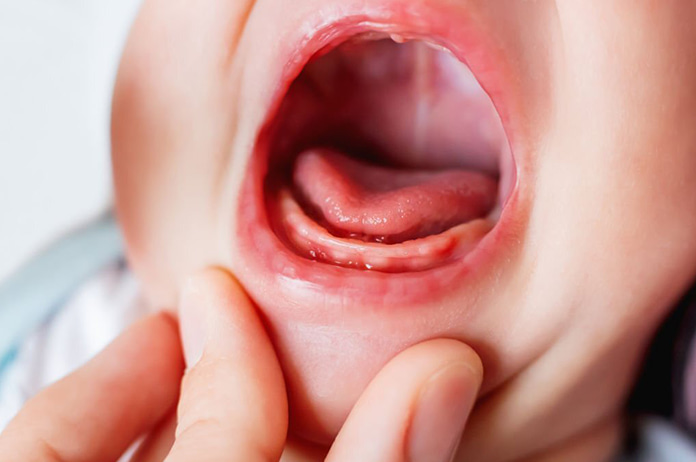
If your child is experiencing white patches on the tongue and inside the mouth, it may be thrush! Oral thrush, caused by a fungus, is a common infection in infants.
Oral Thrush in Children: What Is It?
Oral thrush in children is a mild infection caused by white patches, which is a fungus that grows in the child’s mouth.
This infection affects between 5 to 7% of children and can sometimes be transmitted during childbirth, following vaginal yeast infection. However, this mode of transmission is still somewhat rare. “Children often get infected by putting contaminated toys in their mouths. Or when an adult or sibling puts their pacifier in their mouths and then returns it to the child, as the yeast does not show symptoms after” one year of age “.
Oral thrush usually disappears in children on its own. However, treatment may be necessary if oral thrush is painful for the child.
Symptoms of Oral Thrush
- White patches or white spots on the tongue, inside the cheeks, and on the lips.
Pediatricians warn that “care should be taken not to confuse these white spots with milk residues”. To do this, he offers a very simple trick: “Wrap your finger with gauze and gently rub your child’s oral mucosa. If the milk residue disappears, it will disappear. Otherwise, it is certainly thrush.
Oral thrush can be very embarrassing for the child as it may prevent proper breastfeeding. It seems like the canker sores we know.
How Is Oral Thrush Treated in Infants?
To relieve pain, the pediatrician or doctor prescribes a gel to clean the child’s mouth and relieve pain.
Improvement will be felt after about three days.
When to Worry?
However, be wary of complications, as oral thrush can lead to diarrhea and diaper rash due to an imbalance in the child’s gut flora.
The pediatrician says, “This sometimes happens when the child is taking antibiotics. Then it should be given in the form of a liquid solution, three or four times a day during breastfeeding, and everything will return to normal quickly.”
Oral thrush can also be treated with homoeopathy. To learn more, see our article on homoeopathic treatment for oral problems.
Thrush and Breastfeeding
Apart from the difficulty of feeding the child, there is a risk to the mother. She may develop thrush in the nipple, or even in the milk ducts, at the level of the mammary gland.
This manifests itself through pain during breastfeeding. Mothers describe needles in the breast, and breastfeeding becomes painful. But many diagnoses of thrush are made by mistake, which is why in case of symptoms of this kind, it is important to consult a breastfeeding specialist.
Then natural treatment is suggested. “Gentian violet, a 1% concentrated dye, should be painted in the child’s mouth before breastfeeding. By placing the child on the breast, the solution will rise to the gland to treat it. But be careful not to extend this treatment for more than a week,” specialists confirm.
How to Avoid Recurrence of Oral Thrush?
Once the baby is treated, the important thing is to avoid further contact with the fungus. To minimize the transmission of oral thrush:
- Sterilize bottle nipples and pacifiers,
- Replace the pacifier with a new one once the baby is healed,
- Wash your hands thoroughly and regularly,
- Regularly clean these toys or items that are put in his mouth with a suitable product. You can boil toys, bottles, bibs, towels, and baby wipes for 20 minutes in a covered container of water. It’s tedious, because to be effective, it must be done frequently.