
Asthma in Infants: What is it?
Asthma is a respiratory disease characterized by “asthma attacks” resulting in difficulty breathing (or acute shortness of breath). Asthma in children under 3 years of age is clinically defined as any episode of breathing difficulty accompanied by wheezing that has occurred at least three times since birth.
Therefore, if your child under 36 months has experienced at least 3 episodes of bronchitis, nasal pharyngitis, or bronchiolitis, it is essential to determine whether they are suffering from asthma.
Asthma attack in infants may manifest as:
- Dry cough, rapid wheezing upon breathing, and rapid flaring of the nostrils.
- Difficulty breathing, widening of the spaces between the ribs and above the collarbones, and chest retractions even when not breathing.
- The child appears very pale, and their lips may turn bluish.
- The child has difficulty eating and drinking because they are tired.
Faced with one or more of these symptoms, you should consult your doctor immediately or seek emergency services.
A severe asthma attack’s symptoms may resemble those of bronchiolitis. Recurrence is what should alert.
Asthma in infants can also manifest through other (less suggestive) symptoms, such as:
Wheezing without coughing, occurring outside of attacks, with no effect on the child’s overall condition or activity.
Coughing triggered by exertion (when the child walks or cries or is agitated).
Coughing occurring at night.
Chronic cough or frequent coughing episodes.
Persistent coughing after bronchiolitis. In everyday language, we often talk about “asthmatic bronchitis,” “asthmatic cough,” “recurrent bronchiolitis,” etc.
A severe asthma attack’s symptoms may resemble those of bronchiolitis. Recurrence is what should alert.
Asthma in infants can also manifest through other (less suggestive) symptoms, such as:
- Wheezing without coughing, occurring outside of attacks, with no effect on the child’s overall condition or activity.
- Coughing triggered by exertion (when the child walks or cries or is agitated).
- Coughing occurring at night.
- Chronic cough or frequent coughing episodes.
- Persistent coughing after bronchiolitis. In everyday language, we often talk about “asthmatic bronchitis,” “asthmatic cough,” “recurrent bronchiolitis,” etc.
Personal (eczema, allergic rhinitis, food allergy) or family (asthma, allergic rhinitis, eczema in parents and/or siblings) history signs will reinforce the suspicion of asthma.
Asthma in Infants: Causes
This rapid increase cannot be fully explained today. It may be partly due to environmental factors: different exposure to infectious agents, children being more susceptible to viral infections… The direct causes are not yet known, but on the other hand, we know the factors that favor asthma in infants:
- Exposure to tobacco smoke
- Air pollution (especially diesel pollution)
- Allergies
- Viral infections
When a child is exposed to a virus, tobacco, or an allergen, it irritates the airways, which become inflamed and produce mucus (increased airway activity). The muscle of the airways contracts, and air does not pass through the airways. This is asthma in infants, a chronic inflammation of the airways.
Asthma in Infants: Diagnosis
When asthma is suspected, a chest X-ray is performed from the front, during exhalation and inhalation, to rule out other diagnoses such as malformations or foreign body inhalation.
If the X-rays are normal, experimental asthma treatment begins. Its effectiveness reinforces the diagnosis of asthma. However, effectiveness may be inconsistent or incomplete without excluding the diagnosis of asthma.
Allergy testing is not systematic in infants: it is carried out if symptoms or signs suggestive of allergy or a notable family history persist. Respiratory function tests can be performed.
Treatment of Asthma in Infants
The severity of asthma (especially depending on the frequency of attacks) determines the choice of treatment.
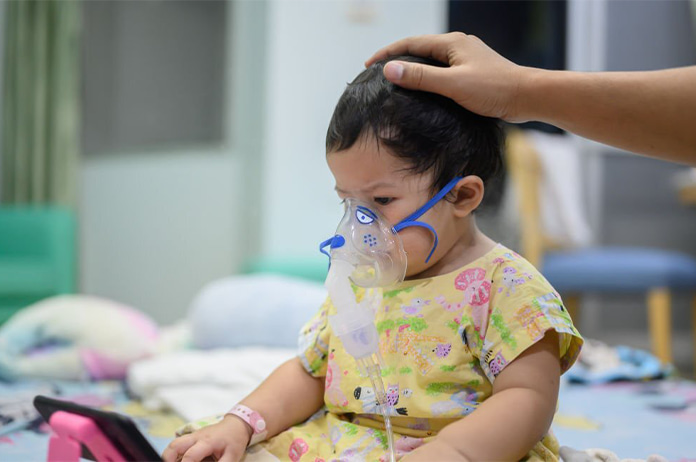
To relieve symptoms of asthma attacks, timed-use medications are prescribed. They aim to relieve breathing difficulties, wheezing, and coughing by inhaling bronchodilators (beta-2 mimetics), and if necessary, internal corticosteroids are prescribed. These products can be used at an early age when the first signs of illness occur.
The basic treatment for asthma in infants ranges from mild continuous to moderate continuous stages. It primarily relies on effective-dose inhaled corticosteroid therapy. This treatment is administered using spacers or compressor/inhalers. “In the short term, disease-modifying treatments reduce the frequency and severity of attacks.” In addition to drug therapy, adherence to hygiene rules is essential. It is also necessary to avoid exposing the asthmatic child to cigarette smoke.
Also, recurrent coughing or wheezing due to viral infection should be prevented. Therefore, it is essential to avoid:
- Placing the asthmatic infant in the presence of cold sufferers.
- Taking them to crowded places.
The following are also recommended:
- Vaccinate asthmatic children over 6 months against influenza (before 6 months, caregivers should receive the influenza vaccine);
- For children with allergies, it is also necessary to reduce exposure to specific allergens: dust mites, animal hair, etc.
Physical therapy sessions can be prescribed in case of excessive airway secretion.
When to Worry?
Consult your doctor or pediatrician immediately in any of the following cases:
- Your child wheezes and does not relieve with a bronchodilator (even after 15 to 20 minutes of use)
- The treatment relieves wheezing but only for a short period
- Your child needs the bronchodilator more than every 4 hours
- The treatment relieves wheezing but after two to three days, the asthma does not improve (for example, your child continues to use the bronchodilator 4 to 6 times a day)
- Symptoms persist or reappear despite prescribed basic treatment
- The crisis seems unusual to you (for example, your child seems exhausted or reacts little to your stimuli, is very embarrassed by breathing and does not drink his bottles well)
- Severe exacerbation occurs (severe symptoms lasting more than 24 hours).
How Does Asthma Develop in Infants?
Half of young children with asthma in infancy will not have asthma as they grow older. “There is a fifty-fifty chance that asthma will disappear in children in childhood.”
On the other hand, 10% of young children will continue to have asthma. “Children who wheeze early and who have severe allergies – those who have eczema, perhaps food allergies – are the ones whose asthma continues into childhood, even into adolescence,” according to pediatricians. Thus, allergy tests provide information on the later development of asthma.
How to Prevent Asthma Attacks?
First of all, avoid exposing your child to irritants such as tobacco. If you smoke, it’s important to try to quit smoking.
During viral infections, enhance cleanliness measures:
- Cough or sneeze into your elbow or a tissue, then dispose of it properly
- Wash your hands frequently with soap (especially after blowing your nose, coughing, or sneezing)
- Do not kiss your child on the face if you are sick, and protect them by wearing a mask
- Clean your child’s nose when they have nasal pharyngitis
- Trim your child’s nails frequently to maintain cleanliness
If your child has allergies, limit exposure to allergens with several precautions:
- Use dust mite covers and wash bedding frequently
- Remove carpets and rugs if possible
- Clean mold
- Keep pets away from your child’s room, or even your home entirely
- Get a vacuum cleaner with a HEPA filter, which traps the smallest allergens (mites, pollen, mold, etc.)
- Invest in an air purifier


.)