

Body Mass Index
With various campaigns warning about childhood obesity, many parents are now, more than ever, seeking to control this aspect of their child’s growth. But don’t overdo it. As with everything, moderation is key.
Baby’s Weight
The weight a baby takes until food diversification (between 4 and 6 months) is not a problem. Their diet depends solely on milk (breast or formula), so everything the baby takes is beneficial. Generally, babies do not need extra flour in their bottle unless advised by a doctor.
Therefore, today, your baby’s weight between 0 and 4-6 months is regularly examined by your doctor or pediatrician anyway.
Baby’s Weight Month by Month
Baby’s Weight in the First Month
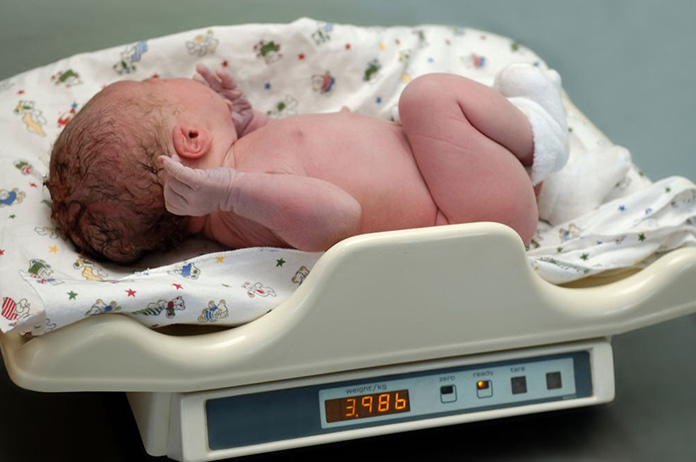
• At birth, the baby may weigh between 2,630 and 4,580 grams for boys, and between 2,630 and 4,260 grams for girls. The average is 3,400 grams.
Their length ranges between 46 and 54 centimeters, averaging 50 centimeters.
During the first week, the baby loses between 5 to 10% of their weight, which should be compensated by around the fifteenth day at the latest.
Then they’ll gain about 200 grams weekly.
Baby’s Weight at Two Months Old
The baby gains about 20 grams daily. Not on a regular basis, of course. Weighing the baby after every feeding won’t help you. Similarly, you won’t reassure yourself by weighing them every day. There’s no regularity and recording. The main thing is that they’re gaining weight. A visit to the pediatrician confirms that.
Baby’s Weight at Three Months Old
The baby is still growing rapidly, gaining about 150 grams per week. At 3 months old, the baby weighs an average of 5 kilograms. I say on average because some babies may have already reached 7 kilograms.
Baby’s Weight at Four Months Old
Weight gain accelerates by about 800 grams this month. At 4 months old, the average baby weighs 6.5 kilograms for boys and 6 kilograms for girls. Some babies may have already reached 7 kilograms.
Baby’s Weight at 5 Months Old
About 700 grams this month.
Their weight ranges between 5.5 kilograms and 8.5 kilograms depending on their size.
Baby’s Weight at 6 Months Old
The baby will gain, on average, 600 grams this month. So, at 6 months old, the baby weighs between 6 and 9 kilograms.
Pay attention to excess or insufficient weight.
Don’t worry too much as long as the curve continues on an upward trajectory.
Baby’s Weight
A child is considered a baby under 3 years old.
From the moment a child starts tasting non-milk foods, monitoring becomes essential. The child shouldn’t be overloaded with sugary drinks or various and varied cakes under the guise of liking them.
So it’s essential to think about balanced nutrition and recommended dietary allowances.
With all these considerations in mind, we all want to know whether our child is above, average, or below the norms.
The physical aspect can sometimes be misleading; it’s easy to imagine having an underweight child while playfully flirting with the average curve representing the ideal medical model.
To calculate your child’s ideal weight, there’s a method similar to that used for adults today. This is to calculate the Quetelet index or Body Mass Index.
Calculating Body Mass Index
Body Mass Index = Weight / Height²
However, unlike adults, there isn’t just one value after which a child can be considered overweight or underweight. This threshold value depends on the child’s gender and changes with age due to natural variations in obesity during growth. This makes it very difficult to get an idea by weight and size alone.
Practically speaking, it’s necessary to report the Body Mass Index at least once a year on obesity curves found in the medical record.
It doesn’t matter that it doesn’t fall exactly on the average. What matters is that the Body Mass Index falls in the area around the central average (normal weight) and doesn’t change “the passage”. If not, it’s advisable to get medical advice.
While weight measurement is a fundamental element, it’s not enough to assess a child’s obesity properly.