

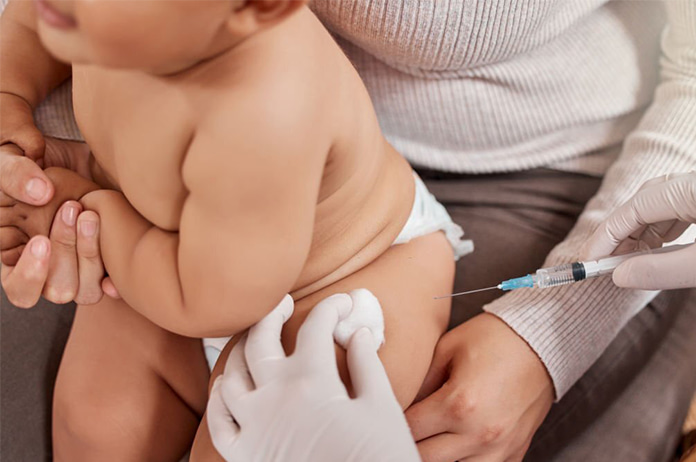
The first months of life are crucial for building infants’ immune systems. At this age, babies are still fragile and have few antibodies. Vaccines allow them to protect themselves from certain diseases by boosting their immune defenses.
Child Vaccination Schedule
Children should receive their vaccinations according to a highly specific schedule.
- In the first month: BCG vaccine against tuberculosis (not mandatory for infants but recommended in some cases).
- In the second, fourth, and eleventh months (3 doses): Vaccines against diphtheria, tetanus, polio, pertussis, Haemophilus influenzae type B, pneumococcal conjugate, and hepatitis B.
- At twelve months: Measles, mumps, and rubella vaccine (first injection).
- Between sixteen and eighteen months: Second injection of the measles, mumps, and rubella vaccine.
When Should the First Vaccine for an Infant Be Administered?
The first vaccination for an infant can be done in the first month if they are to receive the tuberculosis vaccine. Otherwise, the first vaccine is given at two months. Why so early? Simply because at birth, babies are protected by antibodies transferred from their mothers in the womb, but these antibodies decrease in the following months, making them more vulnerable. Vaccines allow infants to acquire immunity to protect them from specific diseases that could have serious consequences on their health.
Which Vaccinations Should Be Administered to a Two-Month-Old Infant?
At two months of age, infants should receive the first dose of vaccines to protect them from 7 types of infections. However, they do not need 7 injections.
Your baby will receive one of these vaccines:
- Triple vaccine (against 3 infections): diphtheria, tetanus, and polio
- Quadruple vaccine (against 4 infections) by adding pertussis to the list
- Pentavalent vaccine (against 5 infections) if it includes Haemophilus influenzae type B
- Hexavalent vaccine protects children from 6 infections, those mentioned before plus hepatitis B. Children should receive the first dose of this vaccine at two months of age, then a second dose between 4 and 5 months, then a booster dose at 11 months of age.
Should Children Receive Influenza and Gastrointestinal Vaccines?
Doctors rarely prescribe the influenza vaccine for infants except in rare cases. This concerns children who have weaknesses such as immunodeficiency. There are no specific recommendations for the influenza vaccine for infant parents. It is also not necessary to give the gastro vaccine to infants unless advised by the doctor or midwife otherwise.
Preparation and Side Effects of Vaccines in Infants
How Do We Vaccinate a Child?
To make the moment of vaccination easier for your child, you need to reassure them. Keep him close to you, on your lap or in your arms. You can also give him the breast if he has been breastfed to make him feel confident. Before the appointment, you can give him a sugary drink, but don’t give him paracetamol. Feel free to use their favorite toys or games.
The sting lasts only a moment. The sensation lasts only a few seconds. The doctor can give a special pain patch for the baby’s vaccine at least one hour before to prepare it, but this is not always necessary. The doctor will choose the injection site according to the baby’s shape. Generally, vaccines are injected into the baby’s thigh or arm.
What are the potential reactions of infants to vaccines?
The side effects of vaccines do not depend on the child’s age, whether they are two months old or 12 months old, but on the type of vaccine administered. These effects are mild and not significant. However, it is important to monitor the child after vaccination. The most common reactions to vaccines in infants aged two months are:
- Occasional localized pain with swelling at the injection site
- Irritability with muscle or joint pain
So it is not uncommon or worrisome for the baby to have a slight fever after vaccination. These side effects dissipate very quickly. It is possible to administer a weight-appropriate dose of paracetamol syrup or equivalent if the fever exceeds 38.5 degrees, which is somewhat rare.
What are the possible risks of vaccines on infants?
After receiving the vaccine, some people may experience more serious side effects, but they are extremely rare. The most serious effect (one case out of 450,000 injections) is an allergic reaction with, for example:
- Skin rash
- Eye swelling
- Low blood pressure
These effects can be quickly overcome. If you notice these symptoms, you should see a doctor immediately or call the emergency room. It is also requested to stay at the site for 20 minutes after the injection to monitor for possible reactions.
How can you help your child after vaccination?
After vaccination, you should monitor your child for any signs of allergic reactions or vaccine intolerance. You should contact the doctor immediately if you notice the following symptoms:
- Skin rash
- High fever (above 39 degrees)
- Uncontrollable crying or screaming
- Lethargy and drowsiness
- Inflammation at the injection site
If your child is experiencing a slight fever, avoid overdressing them. Paracetamol can be given to children over 3 months old, with dosage considerations based on their age.