

What is Chickenpox?
Chickenpox is one of the most infectious childhood diseases. In 90% of cases, it occurs between 3 months and 10 years of age. It generally manifests through the eruption of blisters on the skin associated with itching.
How is Chickenpox Transmitted?
The virus is transmitted through saliva droplets from an infected person. The virus is highly contagious and can be transmitted “remotely” such as from one room to another, for example: we talk about “airborne” transmission.
It is also possible for the blisters to be contagious at the vesicle stage (blisters topped with a small bubble) because the virus is present in large quantities. However, this mode of contamination is less important than transmission through saliva, and the blisters are no longer contagious when they dry out and give way to scabs.
A person infected with chickenpox is contagious one day before the appearance of the blisters and up to a week after their appearance. You can only contract chickenpox once: acquired immunity after the first contact with the chickenpox virus is permanent and protects against any new contamination with this virus.
Symptoms
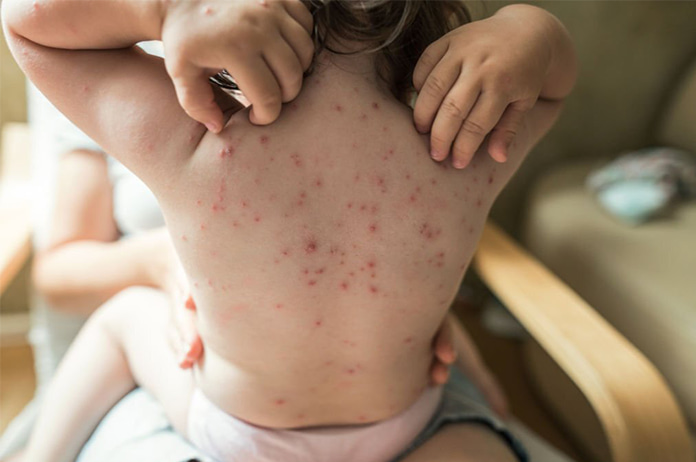
The incubation period (between the entry of the virus into the body and the first symptoms) is silent and lasts from one to two weeks. The first symptoms of chickenpox can be discreet or appear in the form of moderate deterioration in general condition (fever at 38 degrees Celsius, headache, etc.). Then a diffuse skin rash appears characteristic of the disease – the initial elements on the chest and along the hairline. Then the skin rash spreads all over the body causing intense itching.
The development of the blisters occurs in several stages:
- They first appear as small red spots on the skin (“spots”), which rapidly end up as “macules.” Some do not change in appearance while others turn into “pustules” topped with a small bubble filled with clear fluid, giving the impression of “dew drops carefully placed on healthy skin.” The clear fluid of the pustules is highly infectious because it is filled with viruses.
- The blister dries out from the second day and gives way to the formation of a crust between the fifth and seventh day to reveal a red and white scar. The scars usually fade within a few months.
- Generally, the eruption develops in 2 or 3 separate waves from day to 3 days with coexistence on the skin of blisters of different ages: spots, macules, pustules, and scabs.
- The skin rash lasts for 10 to 12 days then disappears spontaneously. It can be accompanied by fever, often moderate, as well as small lymph nodes.
Note: The disappearance of clinical signs does not correspond to the complete elimination of the virus from the body: at this stage, the virus “leaves” the skin tracing the nerve pathways and reaches the spinal cord ganglia where it remains in a silent state. We are talking about the time of virus shedding. Generally, this shedding period is permanent, and the virus is never reactivated.
Differential Diagnosis
Chickenpox diagnosis should not be confused with:
- Insect bites
- Wide-spread herpes infection
- Herpes zoster (bacterial skin infection with blister formation)
Diagnosis and Complementary Analyses
Chickenpox diagnosis is clinical and is made based on the presentation of at least one typical blister on the skin. Direct virus search by sampling is only carried out in case of complications (virus presentation in the blisters, virus antigen detection, antibody search directed against the virus, etc.).
Evolution
The prognosis is usually good, as chickenpox resolves spontaneously within 10 to 12 days. It leaves no traces, except for scars on the skin when the blisters are scratched or infected. The disease may be serious for individuals with immune deficiencies.
Treatment
The child living in a community (daycare or school) and showing signs of chickenpox should be isolated from other children until the scabs fall off to prevent virus transmission. Chickenpox treatment consists of relieving itching and avoiding complications (infection).
- To reduce fever, paracetamol is prescribed, not aspirin, which can cause Reye’s syndrome in children with chickenpox. If the fever is severe, a doctor should be consulted.
- Hygiene measures are important: daily antiseptic cleaning of the blisters and nail cleaning are necessary. They should be cut and kept clean with soap and brush. Avoiding baths is also recommended, generally, avoiding water contact at the onset of eruption as it slows down scab drying.